 Metena
On-chain data: definition and example
Describes data read directly from the blockchain: active addresses, transfers, flows to exchanges. It shows a network’s real usage, not just its price.
Definition
A public blockchain records every transaction. You can count active addresses, volumes transferred, flows to exchanges or the age of the coins that move.
This data needs careful reading: one person can use thousands of addresses, and an exchange groups millions of clients on a few.
How to read the chart
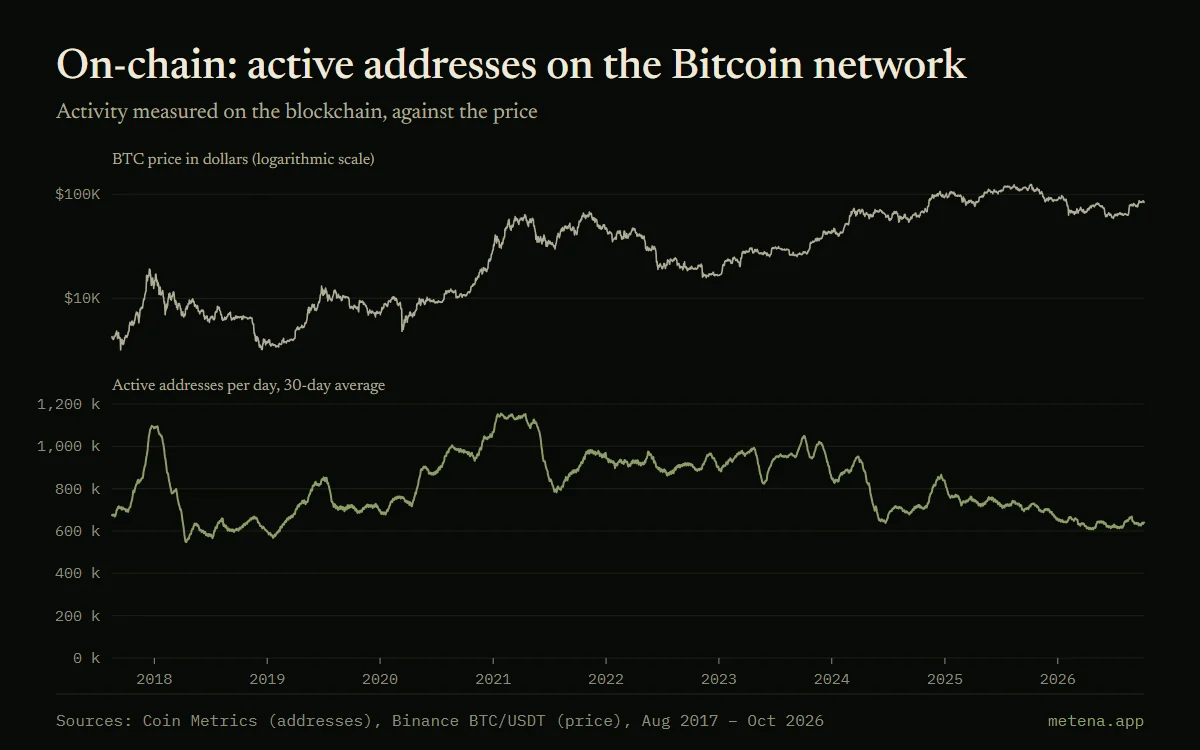
At the top, the bitcoin price on a logarithmic scale. At the bottom, the number of active addresses each day on the Bitcoin network, as a 30-day average.
Compare the two: activity followed the price during manias, then decoupled from it.
Worked example
The 30-day average of bitcoin’s active addresses peaked at 1,155,171 on 26 January 2021. On 7 October 2026, it stands at 640,384, while the price is higher than in 2021.
In Metena
MVRV and net flows to exchanges are among the on-chain data a condition in your Metena strategy can use.
Notify me at launchRelated terms
- MVRV
- The ratio between an asset’s market value and its realized value, meaning the price at which each unit last moved. A high value signals holders sitting on large unrealized gains.
- Spot ETF
- A listed fund that actually holds bitcoin or ether. Its net inflows and outflows serve as an indicator of institutional demand.
- Fear & Greed
- A sentiment index from 0 (extreme fear) to 100 (extreme greed) that combines several measures of market behavior.
- Tokenomics
- The economics of an asset: quantity issued, unlock schedule, distribution, uses. It sheds light on its long-term value.



Put these ideas into practice.
Write your strategy in a few minutes: Metena analyses it when you ask and explains each term in context.
Notify me at launchEducational content. It is not investment advice. Crypto-assets carry a high risk that can go as far as the total loss of capital.