 Metena
ATR (Average True Range): definition and use
The average size of price moves over a period. It is used to gauge volatility and to set consistent risk levels.
Definition
ATR (Average True Range, by J. Welles Wilder) measures the average range of a day. It takes the largest of three gaps: high − low, high − previous close, previous close − low, then averages it over 14 days.
It is mostly used for sizing: placing a stop two or three ATRs from the entry price puts it out of reach of usual noise. Relative to the price, it lets you compare different periods and assets.
How to read the chart
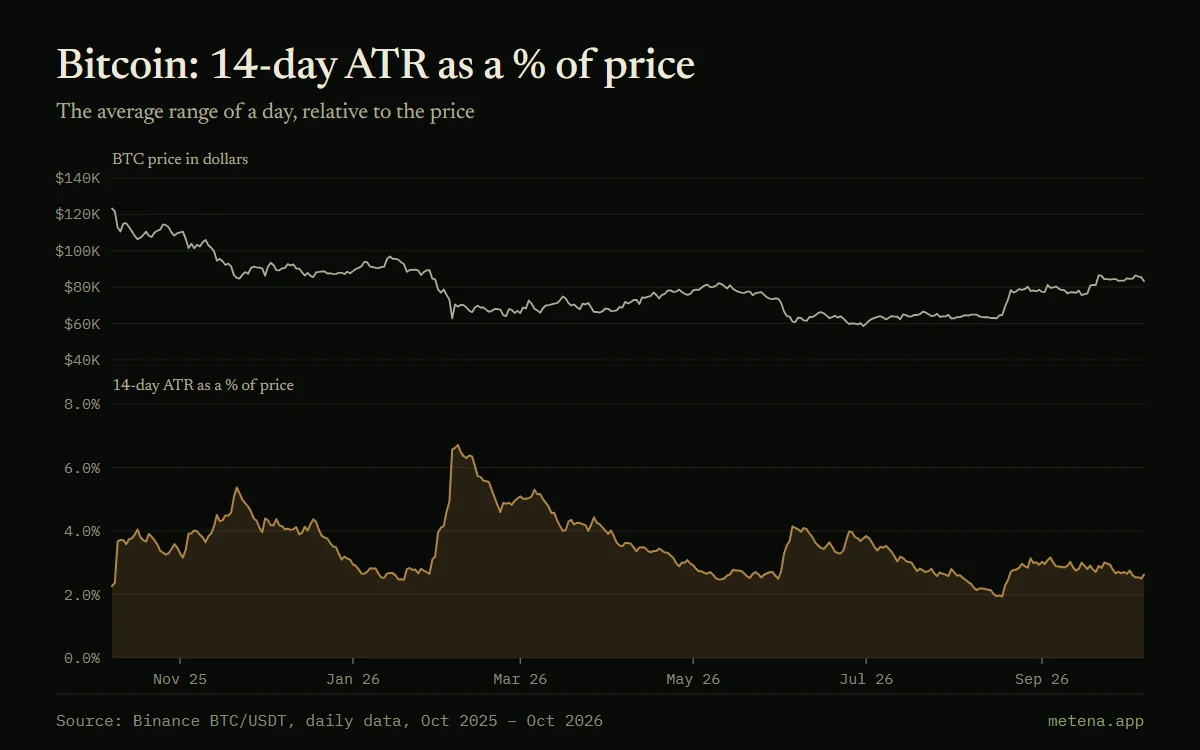
At the top, the bitcoin price over a year. At the bottom, its 14-day ATR as a percentage of the price.
When the curve rises, days become more volatile: a stop placed at the same percentage will be hit more easily.
Worked example
On 7 October 2026, bitcoin’s 14-day ATR is $2,187, or 2.6% of the price. Over the past year, it peaked at 6.7% on 7 February 2026 and touched 1.9% on 18 August 2026. A 2-ATR stop would therefore have sat about 5% below the price in October, and more than 13% below in February.
In Metena
In Metena, the 14-day ATR is one of the indicators you can display on a coin’s chart. The diagnostic also compares your stops with the asset’s actual volatility and flags a fixed stop set on a very volatile asset.
Notify me at launchRelated terms
- Volatility
- The size of an asset’s price swings. High volatility means large moves, up as well as down.
- Money management
- Managing the size of your positions and your exposure: how much to risk per holding, what reserve to keep, which limits never to cross.
- Bollinger Bands
- An envelope drawn around a moving average, two standard deviations wide. It shows whether the price is unusually high or low given its recent volatility.
- Leverage
- Borrowing to take a position larger than your capital. It amplifies gains and losses alike and can lead to the position being liquidated.



Put these ideas into practice.
Write your strategy in a few minutes: Metena analyses it when you ask and explains each term in context.
Notify me at launchEducational content. It is not investment advice. Crypto-assets carry a high risk that can go as far as the total loss of capital.