 Metena
Money management: how to size a position
Managing the size of your positions and your exposure: how much to risk per holding, what reserve to keep, which limits never to cross.
Definition
Money management answers one question before each purchase: how much can I lose on this position if I am wrong? The answer sets the size of the position, not the other way round.
The most common rule caps the loss per position at a small share of capital, often 1% or 2%. The size then follows: accepted risk ÷ distance to the exit point. The further the exit, the smaller the position must be.
For an investor without a stop, the same logic applies to the whole portfolio: the maximum share per asset, the stablecoin reserve and the total decline you accept.
How to read the chart
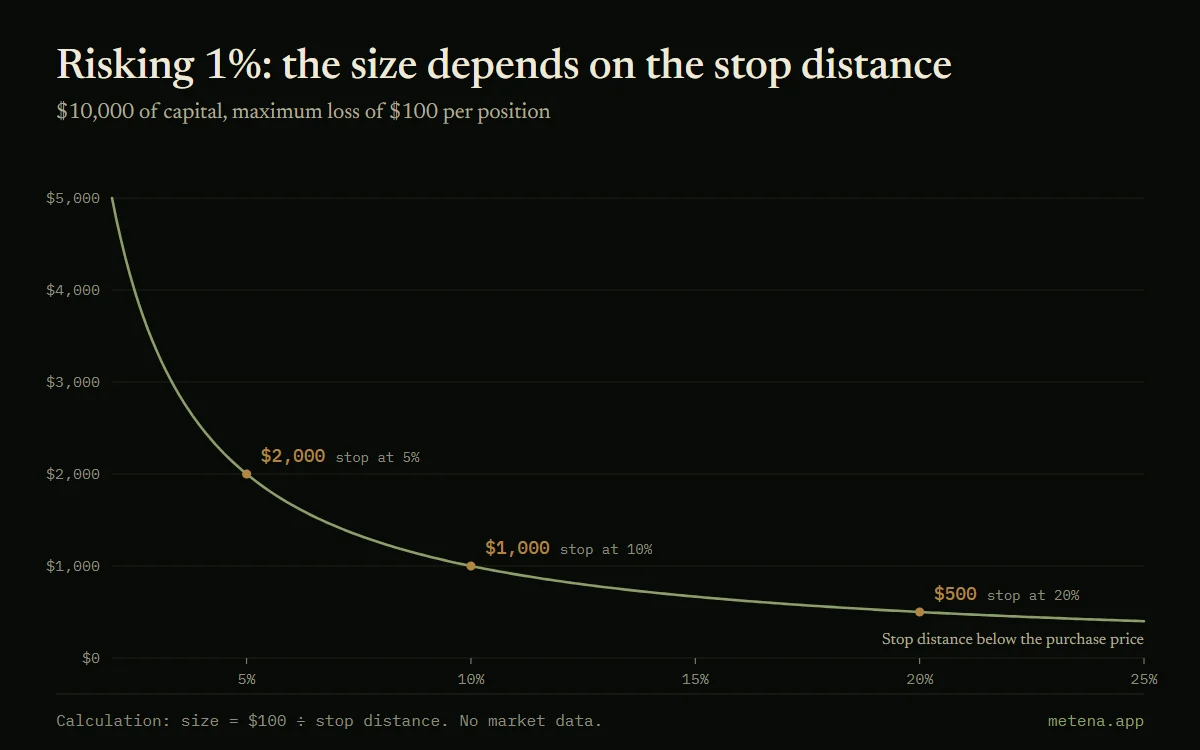
The horizontal axis shows the distance between the purchase price and the planned exit. The curve gives the position size that loses exactly $100, or 1% of $10,000 of capital, if the exit is hit.
This is a calculation without market data: the curve has the same shape for any capital and any asset.
Worked example
With $10,000 of capital and 1% risk per position ($100): a stop 5% below the purchase price allows a $2,000 position; at 10%, $1,000; at 20%, $500. On bitcoin, whose annual volatility often exceeds 50%, a 2% stop will be hit by everyday noise.
In Metena
In Metena, money management is part of the Constitution: maximum size per position, reserve, accepted decline. The diagnostic flags positions that exceed these limits.
Notify me at launchRelated terms
- Leverage
- Borrowing to take a position larger than your capital. It amplifies gains and losses alike and can lead to the position being liquidated.
- Maximum drawdown
- The largest fall, as a percentage, from a peak to the low that follows. It measures what you must be able to withstand without abandoning your strategy.
- Constitution
- In Metena, all your rules written in cold blood: thesis, action rules, invalidation conditions and money management. You reread it the day sticking to it gets hard.
- ATR (Average True Range)
- The average size of price moves over a period. It is used to gauge volatility and to set consistent risk levels.
- Stop-loss
- A price level set in advance, below which you sell to limit the loss on a position.


Related guides
- Building a crypto strategy from A to Z
- Thesis, allocation, position sizing, entry and exit rules, testing: the parts of a written crypto strategy, in the order in which they are decided.
- Crypto risk management: position sizing, leverage and liquidation
- How much to put in each position, what leverage really changes and why diversifying across cryptocurrencies protects little: real bitcoin and ether examples.


Put these ideas into practice.
Write your strategy in a few minutes: Metena analyses it when you ask and explains each term in context.
Notify me at launchEducational content. It is not investment advice. Crypto-assets carry a high risk that can go as far as the total loss of capital.