 Metena
Building a crypto strategy from A to Z
A crypto strategy fits on one page. It says what you buy and why, how much, when you enter, when you exit, and what would make you change your mind. This guide follows those parts in the order in which they are written.
Start from the thesis
The thesis is the reason you think an asset will be worth more tomorrow. It is written in two or three sentences and the facts must be able to contradict it. “Bitcoin will go up” cannot be contradicted. “Bitcoin is establishing itself as a store of value among institutions, which ETF assets under management measure” can be.
Set the horizon too. A five-year thesis can withstand a 50% decline along the way; a six-month thesis cannot. The horizon decides almost everything else: how often you buy, how wide the stops are, how long the thesis is given to prove itself.
Set the allocation
The allocation splits capital between assets: 50% bitcoin, 30% ether, 20% stablecoins, for example. It determines most of the portfolio’s risk.
Two safeguards complete it: a cap per asset, so that no position can take the portfolio with it, and an estimate of the decline you accept to go through. Bitcoin has already lost more than 70% from a high, several times. An allocation is built on the assumption that this will happen again.
Adding more holdings diversifies little: most cryptos follow bitcoin, especially on the way down.
Size each position
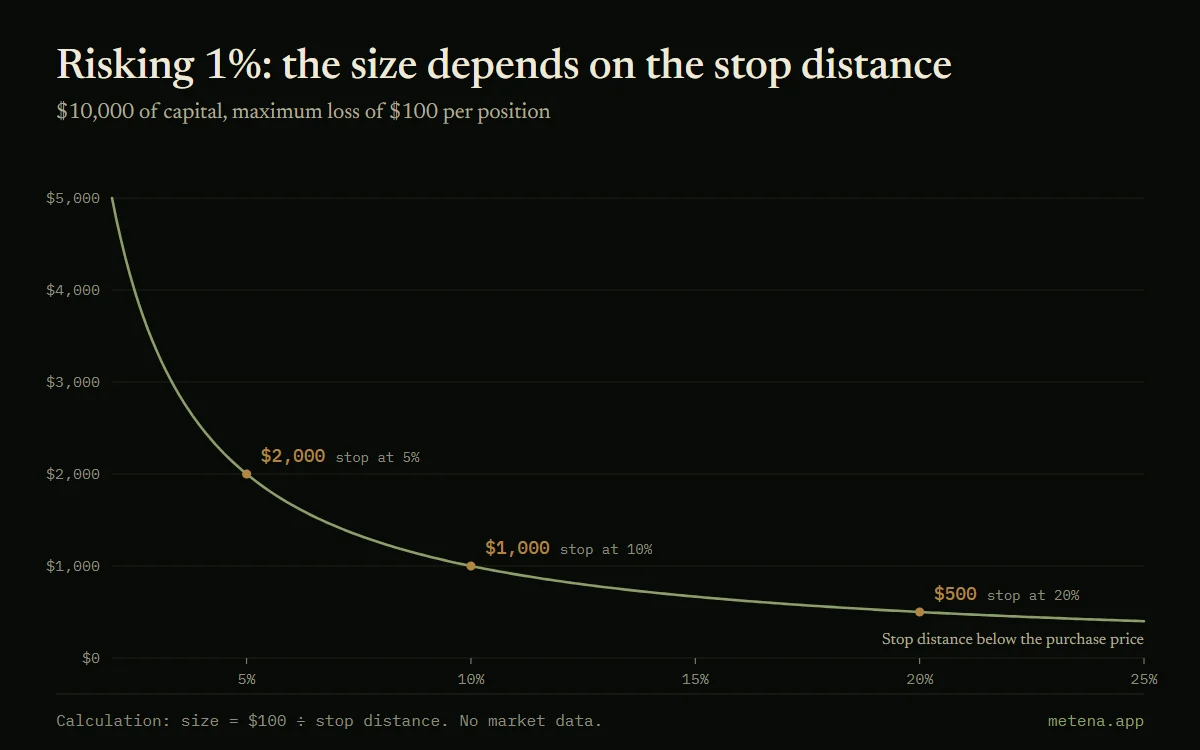
The size of a position follows from the loss you accept. If you limit the loss to 1% of capital per idea and the stop is 20% from the entry price, the position is worth at most 5% of capital.
This rule keeps the portfolio alive through a run of losses. At 1% per position, ten mistakes in a row cost less than 10% of capital. At 10% per position, they cost about 65% of it.
Leverage increases the size without changing the capital and brings the liquidation price closer: with leverage of 5, a decline of about 20% is enough to lose the whole stake.
Write the entry rules
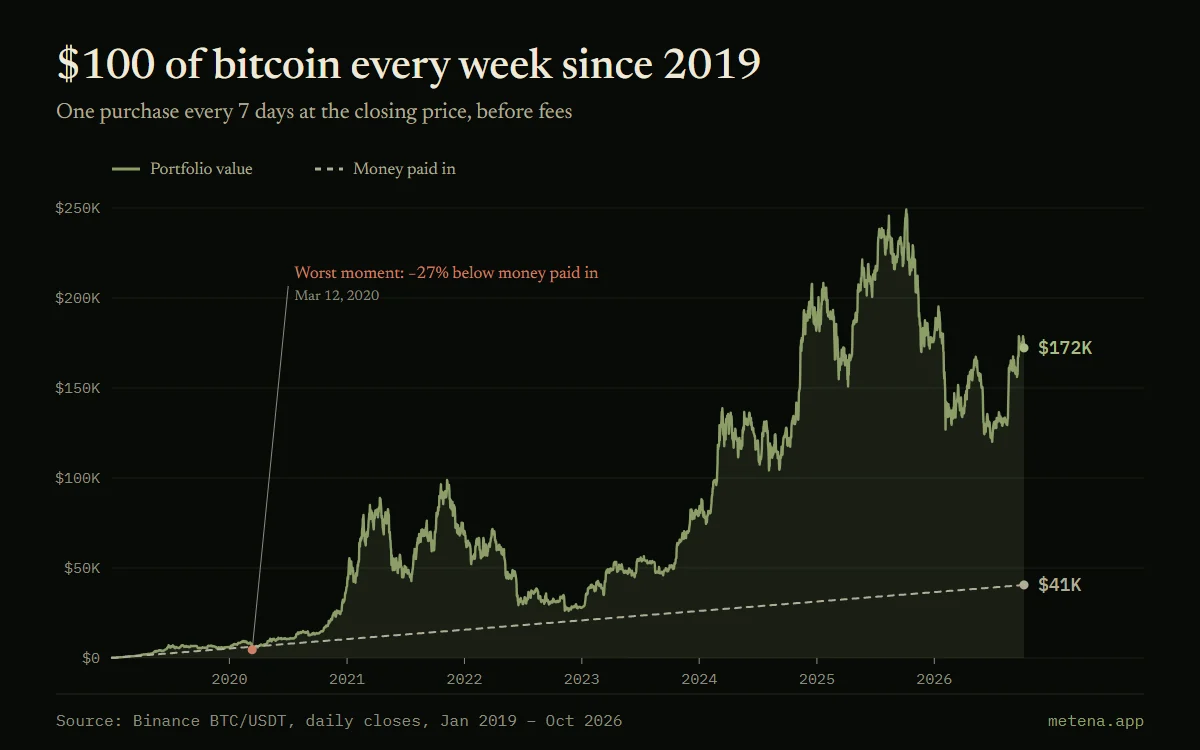
There are two families of rules. Scheduled buying, or DCA, invests a fixed amount at regular intervals and removes the question of timing. Conditional buying waits for a defined signal: a 20% pullback from the high, a return above a moving average.
The two can be combined, provided you write the full rule: the amount, the frequency or the signal, and what stops the purchases. A DCA with no stop condition keeps buying an asset whose thesis has fallen.
Write the exit rules
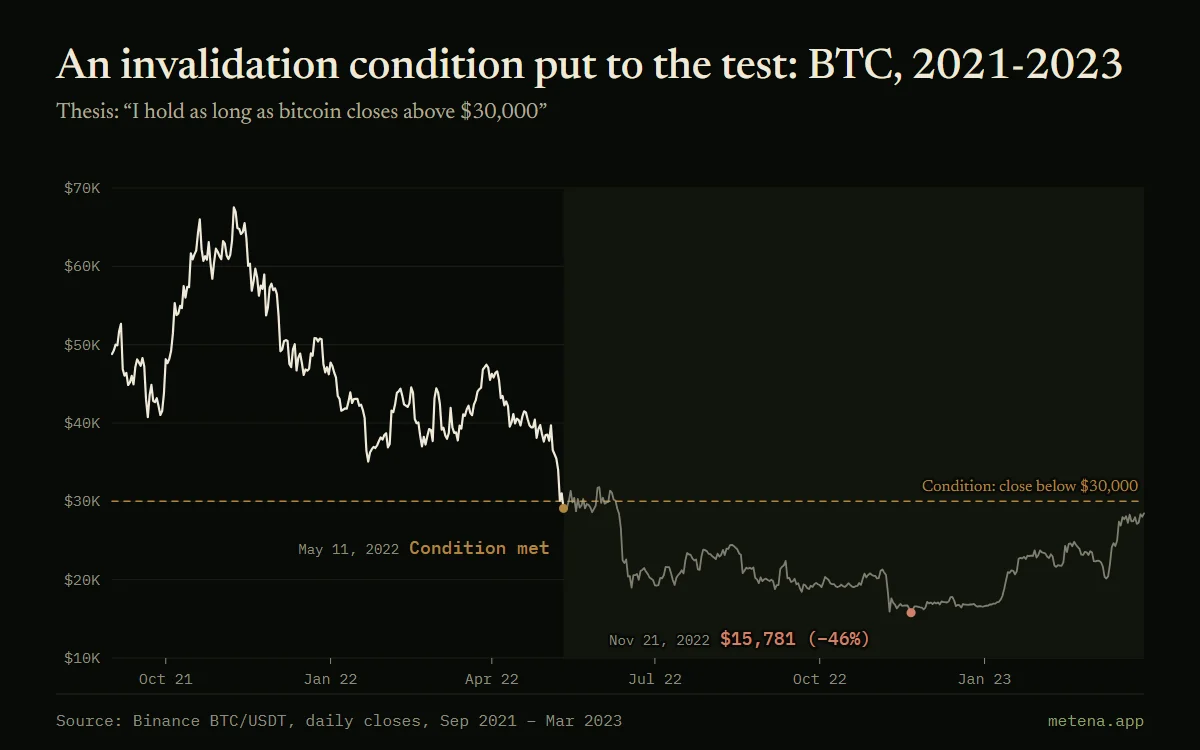
Three exits need to be planned: on the way up, through take-profit levels; on the way down, through a stop; and on the facts, through an invalidation condition that describes what would prove the thesis wrong.
Exits are written with numbers: which price, which share of the position. A rule such as “sell when it has gone up a lot” leaves the whole decision to the moment when it is hardest to make.
Test, then track
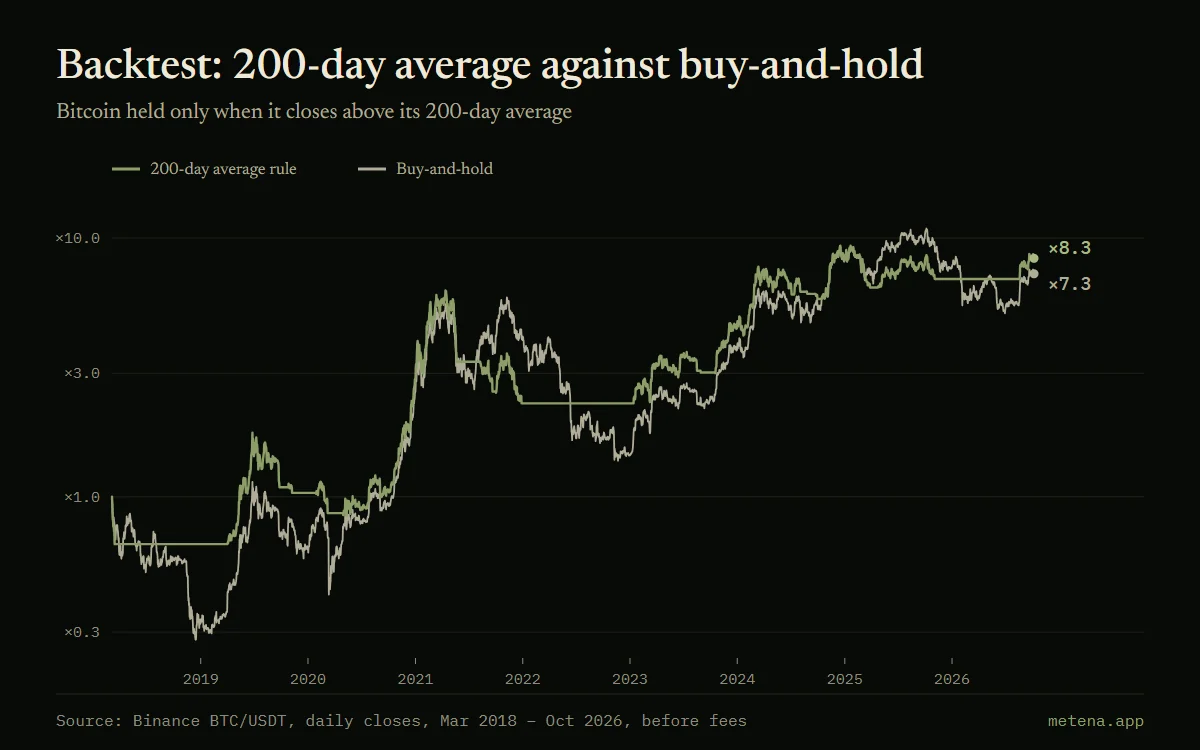
Before committing capital, a backtest applies the rules to the price history. It shows the maximum loss endured, the time spent below the capital invested and how sensitive the result is to the start date. Replaying the crises separately, March 2020 or November 2022, shows what the strategy would have done at the worst moment.
A backtest describes the past and guarantees nothing. Its main use is to rule out the rules you could not have borne to follow.
Then comes tracking. Regularly compare what you hold with what the strategy plans, and note each deviation. Review the strategy on a fixed date, with a cool head. In the middle of a decline, apply it.
In Metena
Metena has you write your thesis before anything else, then analyses it: clarity, horizon, whether invalidation conditions are present. The diagnostic tests it against market data when you ask.
Notify me at launchGlossary terms
- Thesis
- Your reason for investing, written down: why you buy, over what horizon, and what has to happen for you to be right. A clear thesis stops you improvising when the market moves.
- Asset allocation
- How your capital is split between several assets, expressed as target percentages.
- Money management
- Managing the size of your positions and your exposure: how much to risk per holding, what reserve to keep, which limits never to cross.
- DCA (Dollar-Cost Averaging)
- Investing a fixed amount at regular intervals, for example every week, whatever the price. It smooths your entry price and stops you hunting for the “right moment”.
- Stop-loss
- A price level set in advance, below which you sell to limit the loss on a position.
- Invalidation condition
- The precise fact that would prove your thesis wrong and trigger your exit, for example “I exit if BTC closes two weeks below $20,000”. Writing it in advance stops you rationalizing it later.
- Backtest
- Replaying a strategy on past data to measure what it would have delivered. Useful for testing rules, but the past does not predict the future.


Related guides
- Bitcoin DCA: what seven years of data show
- Investing a fixed amount in bitcoin every week: real results since 2019, comparison with a lump sum, the worst time to start and the average cost.
- How to read a crypto backtest without being fooled
- Return, maximum drawdown, overfitting, Monte Carlo: how to read the results of a crypto strategy backtest, with real bitcoin examples.
- Writing your investment thesis and invalidation conditions
- How to write a crypto investment thesis, turn it into rules and set invalidation conditions, with the real examples of Terra-LUNA and FTX in 2022.
- Crypto risk management: position sizing, leverage and liquidation
- How much to put in each position, what leverage really changes and why diversifying across cryptocurrencies protects little: real bitcoin and ether examples.
- When to sell your crypto: writing your exit plan
- Take-profit levels, stop, invalidation condition, rebalancing: four reasons to sell that should be written before buying, with worked examples.


Put these ideas into practice.
Write your strategy in a few minutes: Metena analyses it when you ask and explains each term in context.
Notify me at launchEducational content. It is not investment advice. Crypto-assets carry a high risk that can go as far as the total loss of capital.