 Metena
Stress test: the March 2020 crash
Simulating your rules through a historical shock, such as the March 2020 crash, the LUNA collapse or the FTX bankruptcy, to see what they would have absorbed.
Definition
A stress test takes a real episode or a defined shock (−50% in a month, an exchange that fails, a stablecoin that loses its peg) and calculates what your positions would have taken.
It answers a question averages hide: what happens during the few days when everything goes wrong at once? Liquidations, overloaded exchanges and price gaps matter more there than the trend.
How to read the chart
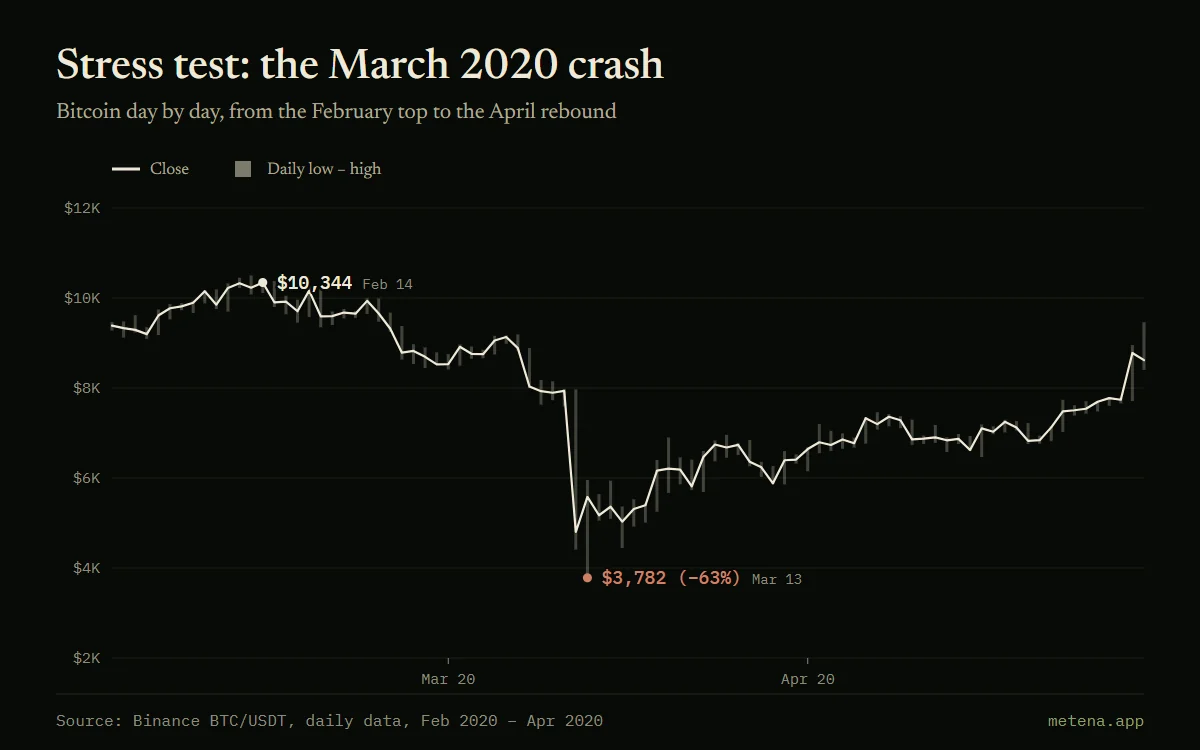
The bright line follows bitcoin’s closes from February to April 2020. The grey bars run from each day’s low to its high: on 12 and 13 March, the intraday range exceeds several thousand dollars.
The labels mark the February top and the March low, with the fall between the two.
Worked example
Bitcoin closes at $10,344 on 14 February 2020. On 12 March, it goes from $7,935 to $4,800 in a single day (−40%), then hits a low of $3,782 on 13 March: −63% from the February top. On 30 April, it closes at $8,620.
In Metena
Metena’s stress test replays on your strategy the March 2020 crash, the Terra-LUNA collapse, the Celsius/3AC contagion, the FTX failure, the USDC depeg and the August 2024 yen carry-trade unwind, as well as synthetic shocks.
Notify me at launchRelated terms
- Maximum drawdown
- The largest fall, as a percentage, from a peak to the low that follows. It measures what you must be able to withstand without abandoning your strategy.
- Leverage
- Borrowing to take a position larger than your capital. It amplifies gains and losses alike and can lead to the position being liquidated.
- Stablecoin
- A crypto-asset designed to hold a stable value, usually pegged to a currency such as the dollar. Often used as a reserve so you are not 100% invested.
- Monte Carlo simulation
- A method that generates thousands of possible paths from your rules, to see the range of outcomes instead of a single scenario. Each path is a possible future, not a forecast.


Related guides
- Writing your investment thesis and invalidation conditions
- How to write a crypto investment thesis, turn it into rules and set invalidation conditions, with the real examples of Terra-LUNA and FTX in 2022.


Put these ideas into practice.
Write your strategy in a few minutes: Metena analyses it when you ask and explains each term in context.
Notify me at launchEducational content. It is not investment advice. Crypto-assets carry a high risk that can go as far as the total loss of capital.