 Metena
Writing your investment thesis and invalidation conditions
Most large losses do not come from a bad analysis at the start, but from the absence of a decision afterwards: you keep a position because you no longer know what was supposed to happen. Writing your thesis and invalidation conditions before buying solves this. This guide shows how, with two 2022 collapses where a condition written in advance changed everything.
From thesis to rules, then to invalidation
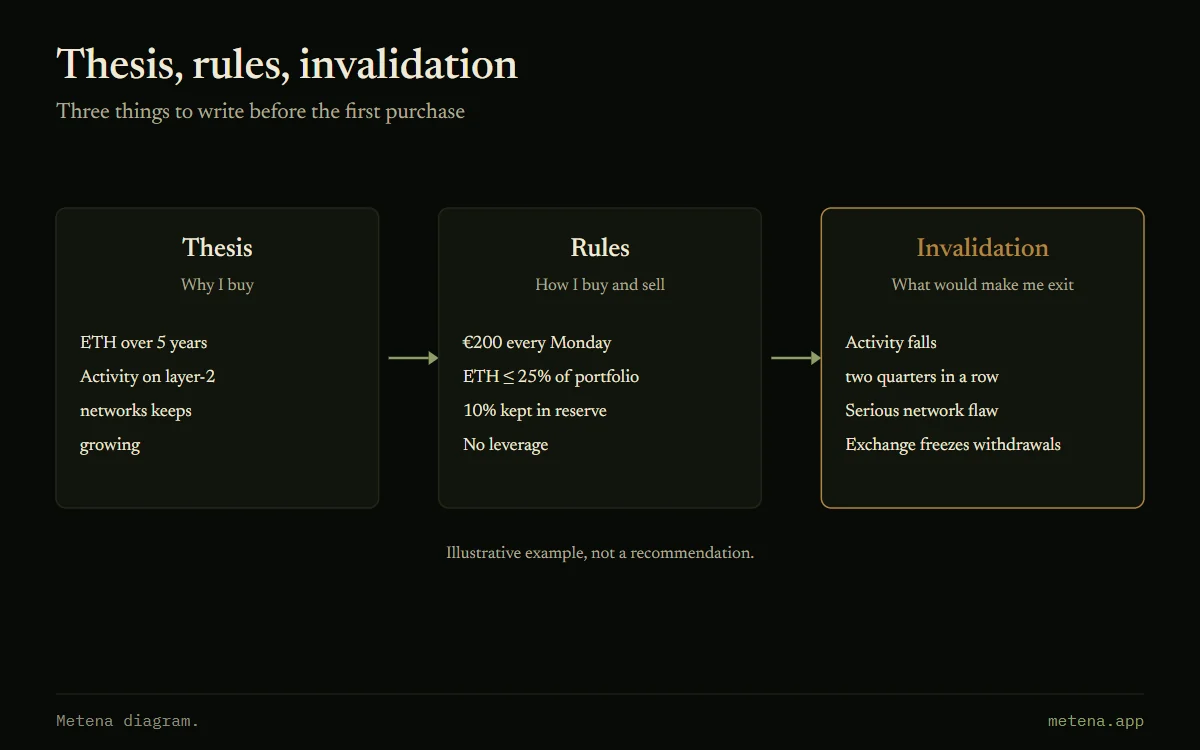
The thesis says why you buy and what has to happen for you to be right. The action rules say how you buy and sell: amount, frequency, maximum size. The invalidation conditions say which facts would prove the thesis wrong.
The three go together. A thesis without invalidation conditions can be defended forever. Rules without a thesis come down to following the price. Invalidation conditions without a thesis do not know what they protect.
What makes a good invalidation condition
Anyone can observe it, it is dated and it needs no interpretation. “BTC closes below $30,000” is a condition. “The market turns bearish” is not: everyone will read it their own way, and you will read it the way that suits you.
It is best tied to what the thesis rests on rather than to price alone. A price being crossed says the market disagrees with you; a fact that contradicts the thesis says you were wrong. Both types have their place, provided they are written before buying.
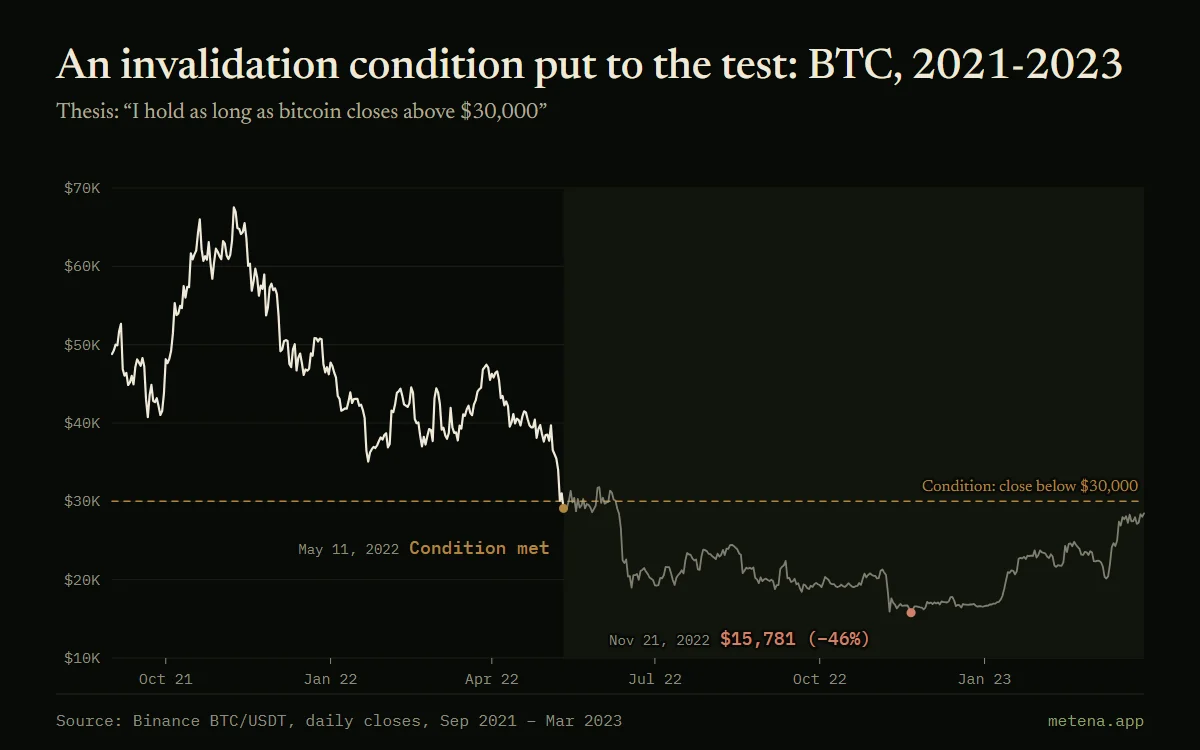
A price example: a thesis set in September 2021 with the condition “I exit below $30,000”. The threshold is crossed on 11 May 2022 at $29,104. Bitcoin then falls to $15,781 in November.
Terra-LUNA, May 2022: a condition on the peg
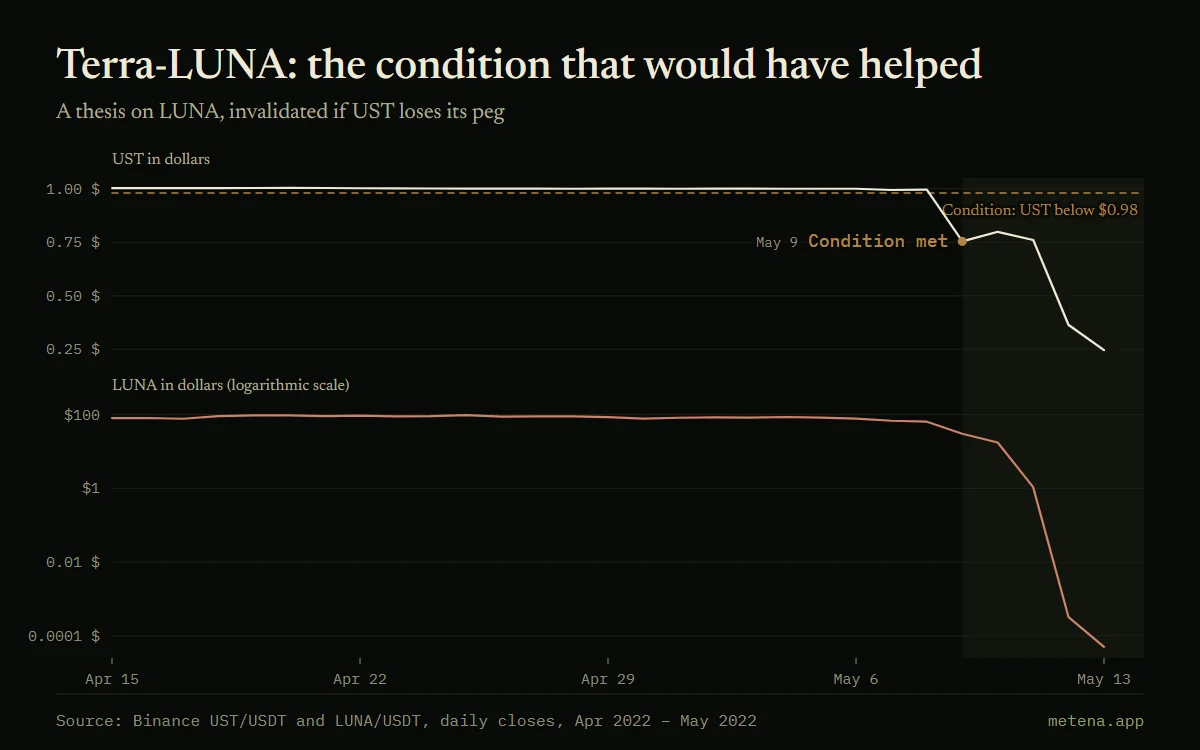
In April 2022, LUNA was one of the ten largest crypto-assets. Its value rested on a mechanism meant to keep the UST stablecoin at $1. A thesis on LUNA therefore rested on a fact you could check every day: UST holds its peg.
A natural invalidation condition was “I exit if UST closes below $0.98”. It triggered on 9 May 2022, when UST closed at $0.75. That day, LUNA still closed at $30.29, against $96.93 on 25 April. Four days later, on 13 May, LUNA was worth $0.00005.
The condition would not have avoided the loss already taken since the top. It would have avoided the total loss. That is what an invalidation condition is for: exiting when the reason to be there disappears, not at the best price.
FTX, November 2022: a condition on a fact
Not every condition is about a price. For funds left on an exchange, or for a token tied to an exchange such as FTX’s FTT, the thesis assumes the exchange stays solvent and honours withdrawals.
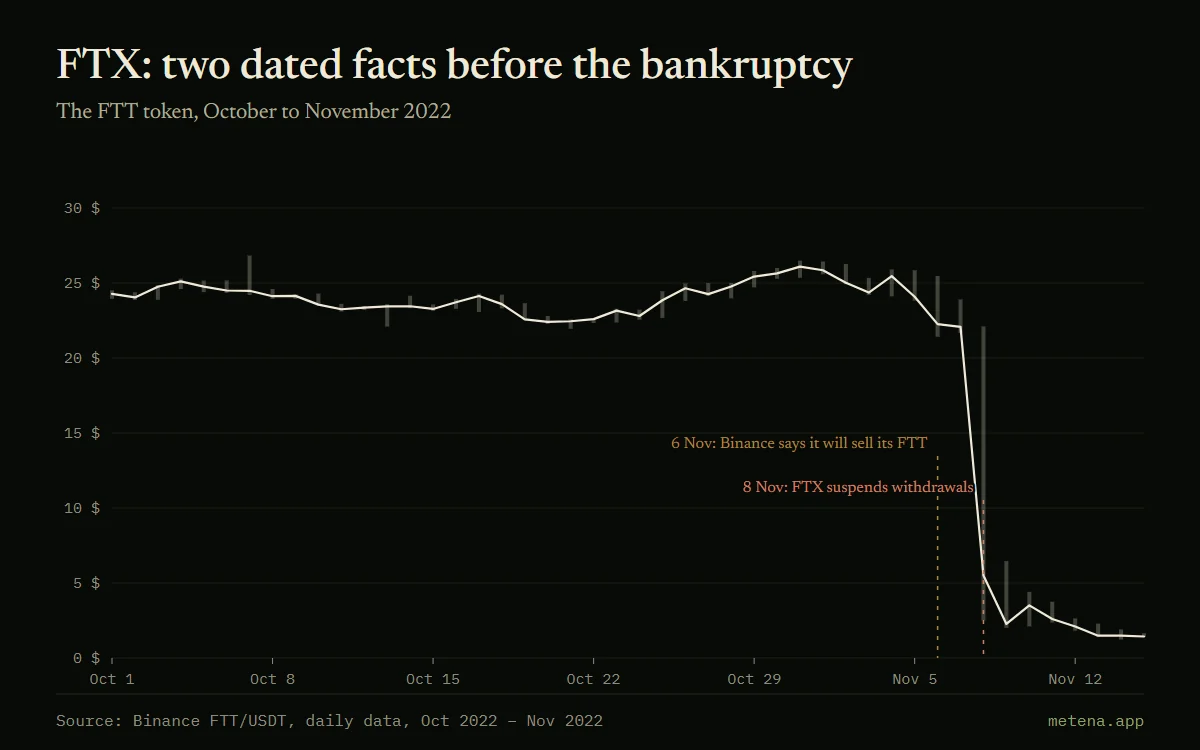
FTT closes at $24.08 on 5 November 2022. On the 6th, Binance’s chief executive announces the sale of its FTT: close at $22.26. On 8 November, FTX suspends withdrawals: FTT closes at $5.50. FTX files for bankruptcy three days later. On 15 November, the last day of trading on Binance before a long suspension, FTT is worth $1.43.
A condition “I withdraw my funds and exit if the exchange suspends withdrawals” triggered on the 8th. A more cautious one, “I reduce if a major shareholder announces it is selling”, triggered on the 6th, when the price had barely moved.
Three flaws that make a thesis unusable
A thesis that is too vague. “Blockchain will change finance” says neither which asset will benefit, nor over what timeframe, nor how to check it. A useful thesis names an asset, a horizon and a measurable fact.
An invalidation condition that is too remote. “I exit if bitcoin falls to zero” will never trigger in time. The condition must be one that can be crossed while there is still something left to save.
A thesis rewritten after the fact. When the price falls, it is tempting to move the threshold or add a reason to stay. Date your thesis and keep the earlier versions: if the reason to buy has changed three times in six months, there is no thesis left.
The invalidation condition also sets the size
The invalidation condition tells you the loss to expect if you are wrong. If it sits 40% below the purchase price, that is what the position can lose. The size is chosen accordingly: 5% of the portfolio exposed to a 40% loss means 2% of the portfolio at stake.
A condition on a fact, such as a suspension of withdrawals, does not give an exit price in advance. The loss can be far larger than planned, as with FTT. That is a reason to keep these positions small.
Writing yours
Start with one sentence: “I buy [asset] over [horizon] because [reason]”. Add what has to happen for you to be right, then two or three facts that would prove the opposite. Then write what you will do if one of them happens: sell everything, cut by half, stop buying.
Reread the thesis on a fixed schedule, for example every quarter, and whenever the price moves more than 30%. If the thesis holds, the decline calls for no decision. If a condition is met, the decision is already made: all that remains is to apply it.
The examples in this guide are historical and illustrative. They are not investment advice.
In Metena
Metena has you write your thesis before anything else, then analyses it: clarity, horizon, whether invalidation conditions are present. The diagnostic tests it against market data when you ask.
Notify me at launchGlossary terms
- Thesis
- Your reason for investing, written down: why you buy, over what horizon, and what has to happen for you to be right. A clear thesis stops you improvising when the market moves.
- Invalidation condition
- The precise fact that would prove your thesis wrong and trigger your exit, for example “I exit if BTC closes two weeks below $20,000”. Writing it in advance stops you rationalizing it later.
- Constitution
- In Metena, all your rules written in cold blood: thesis, action rules, invalidation conditions and money management. You reread it the day sticking to it gets hard.
- Stablecoin
- A crypto-asset designed to hold a stable value, usually pegged to a currency such as the dollar. Often used as a reserve so you are not 100% invested.
- Stress test
- Simulating your rules through a historical shock, such as the March 2020 crash, the LUNA collapse or the FTX bankruptcy, to see what they would have absorbed.


Related guides
- Building a crypto strategy from A to Z
- Thesis, allocation, position sizing, entry and exit rules, testing: the parts of a written crypto strategy, in the order in which they are decided.
- Bitcoin DCA: what seven years of data show
- Investing a fixed amount in bitcoin every week: real results since 2019, comparison with a lump sum, the worst time to start and the average cost.
- How to read a crypto backtest without being fooled
- Return, maximum drawdown, overfitting, Monte Carlo: how to read the results of a crypto strategy backtest, with real bitcoin examples.
- Crypto risk management: position sizing, leverage and liquidation
- How much to put in each position, what leverage really changes and why diversifying across cryptocurrencies protects little: real bitcoin and ether examples.
- When to sell your crypto: writing your exit plan
- Take-profit levels, stop, invalidation condition, rebalancing: four reasons to sell that should be written before buying, with worked examples.



Put these ideas into practice.
Write your strategy in a few minutes: Metena analyses it when you ask and explains each term in context.
Notify me at launchEducational content. It is not investment advice. Crypto-assets carry a high risk that can go as far as the total loss of capital.