 Metena
Invalidation condition: definition and example
The precise fact that would prove your thesis wrong and trigger your exit, for example “I exit if BTC closes two weeks below $20,000”. Writing it in advance stops you rationalizing it later.
Definition
An invalidation condition is observable and dated: a closing price, a duration, a verifiable event. “I exit if BTC closes below $30,000” is one. “I exit if things go badly” is not.
It is written before buying. Once the position is losing, it becomes very hard to set an objective threshold: every level looks like the bottom.
How to read the chart
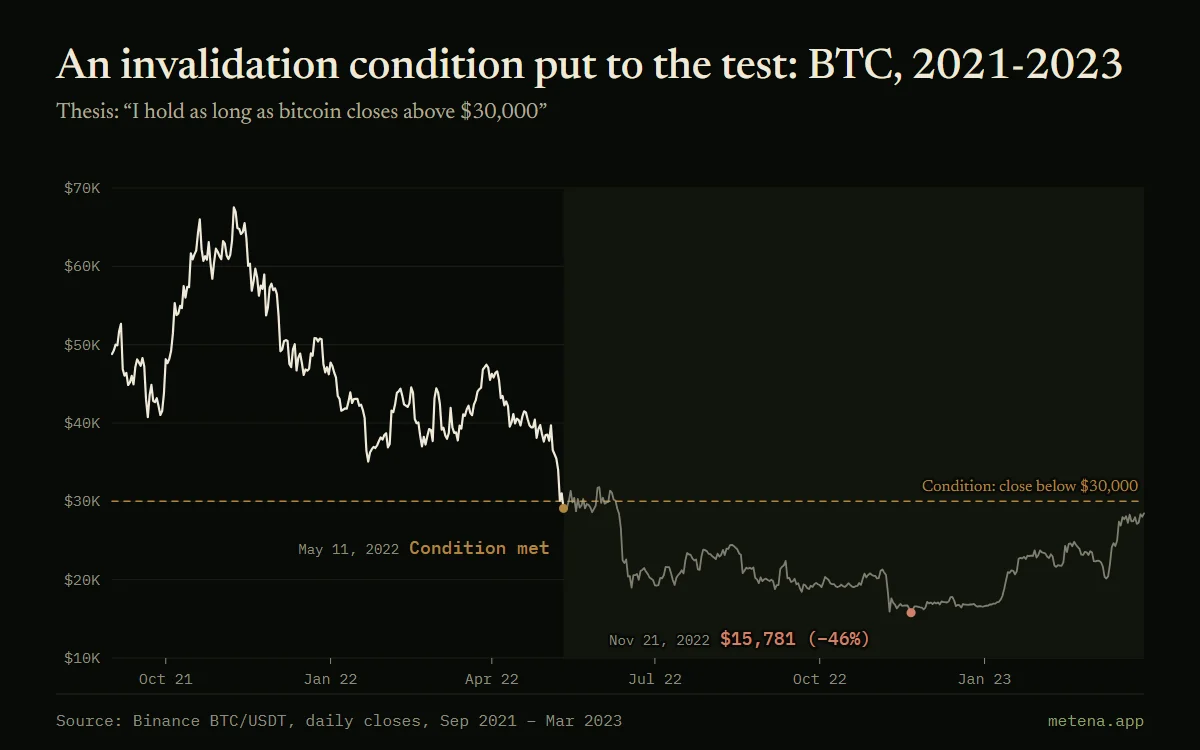
The gold line marks the condition: a bitcoin close below $30,000. The bright line shows the price before the condition was met.
The dark area starts on the day it was. The rest of the price path is grey: it is what an investor would have gone through by ignoring their own rule.
Worked example
For a thesis set in September 2021 with the condition “I exit below $30,000”, the threshold was crossed on 11 May 2022, at a close of $29,104. Bitcoin then fell to $15,781 on 21 November 2022, 46% lower. By 31 March 2023, it was back at $28,465.
In Metena
In Metena, each strategy carries its invalidation conditions. When a market-based condition gets close or is met, you receive an alert. The decision stays yours.
Notify me at launchRelated terms
- Thesis
- Your reason for investing, written down: why you buy, over what horizon, and what has to happen for you to be right. A clear thesis stops you improvising when the market moves.
- Constitution
- In Metena, all your rules written in cold blood: thesis, action rules, invalidation conditions and money management. You reread it the day sticking to it gets hard.
- Maximum drawdown
- The largest fall, as a percentage, from a peak to the low that follows. It measures what you must be able to withstand without abandoning your strategy.
- Stress test
- Simulating your rules through a historical shock, such as the March 2020 crash, the LUNA collapse or the FTX bankruptcy, to see what they would have absorbed.
- Stop-loss
- A price level set in advance, below which you sell to limit the loss on a position.


Related guides
- Building a crypto strategy from A to Z
- Thesis, allocation, position sizing, entry and exit rules, testing: the parts of a written crypto strategy, in the order in which they are decided.
- Bitcoin DCA: what seven years of data show
- Investing a fixed amount in bitcoin every week: real results since 2019, comparison with a lump sum, the worst time to start and the average cost.
- Writing your investment thesis and invalidation conditions
- How to write a crypto investment thesis, turn it into rules and set invalidation conditions, with the real examples of Terra-LUNA and FTX in 2022.
- When to sell your crypto: writing your exit plan
- Take-profit levels, stop, invalidation condition, rebalancing: four reasons to sell that should be written before buying, with worked examples.



Put these ideas into practice.
Write your strategy in a few minutes: Metena analyses it when you ask and explains each term in context.
Notify me at launchEducational content. It is not investment advice. Crypto-assets carry a high risk that can go as far as the total loss of capital.