 Metena
When to sell your crypto: writing your exit plan
Most investors know why they buy. Few know at what price, or in what circumstances, they will sell. This guide goes through the four reasons to sell and shows how to write them before entering a position.
Why the sale is decided before the purchase
Once you are in a position, your judgement changes. A position in profit makes you want to wait a little longer; a position at a loss, to wait for it to come back. In both cases, the decision is put off and ends up being made under pressure.
Writing your exit rules with a cool head solves this problem. Selling at the top is a matter of luck. An exit plan sets, while nothing is urgent, what you will do if the price reaches a given level or if a given fact occurs.
A complete plan covers four cases: the rise, the decline, the thesis that no longer holds, and the position that has grown too large.
Selling on the way up: take-profit levels
Selling in stages means selling a fraction of the position at each level reached. It avoids the choice between keeping everything and selling everything.
Example: bitcoin bought at $50,000, with 25% sold at $75,000, 25% at $100,000, and half kept as long as the thesis holds. At $100,000, the two sales have recovered 87.5% of the initial stake and half of the position is still running.
The levels can be multiples of the entry price or market levels. In both cases, write the share sold at each one: a level without a quantity leaves the decision entirely open.
Selling on the way down: the stop
The stop sets the maximum loss accepted on a position. It is placed where the scenario behind the purchase stops being plausible, at a distance compatible with the asset’s volatility. On bitcoin, moves of 5% within a day are common: a stop at 3% will trigger on an ordinary day.
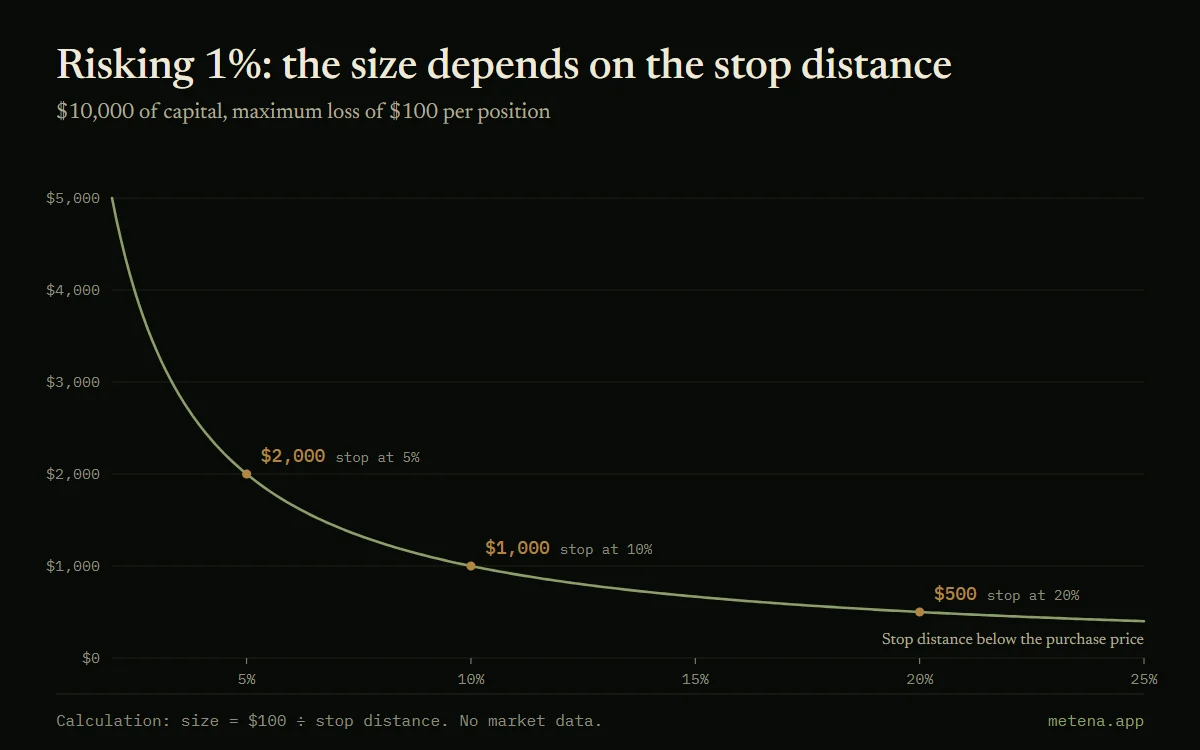
The stop also determines the size of the position. If you accept losing 1% of your capital on an idea and the stop is 15% from the entry price, the position must not exceed 6.7% of capital.
A stop order does not guarantee the execution price. In a fast fall, the sale can go through below the threshold. That is one more reason to size the position with a margin.
Selling because the thesis no longer holds
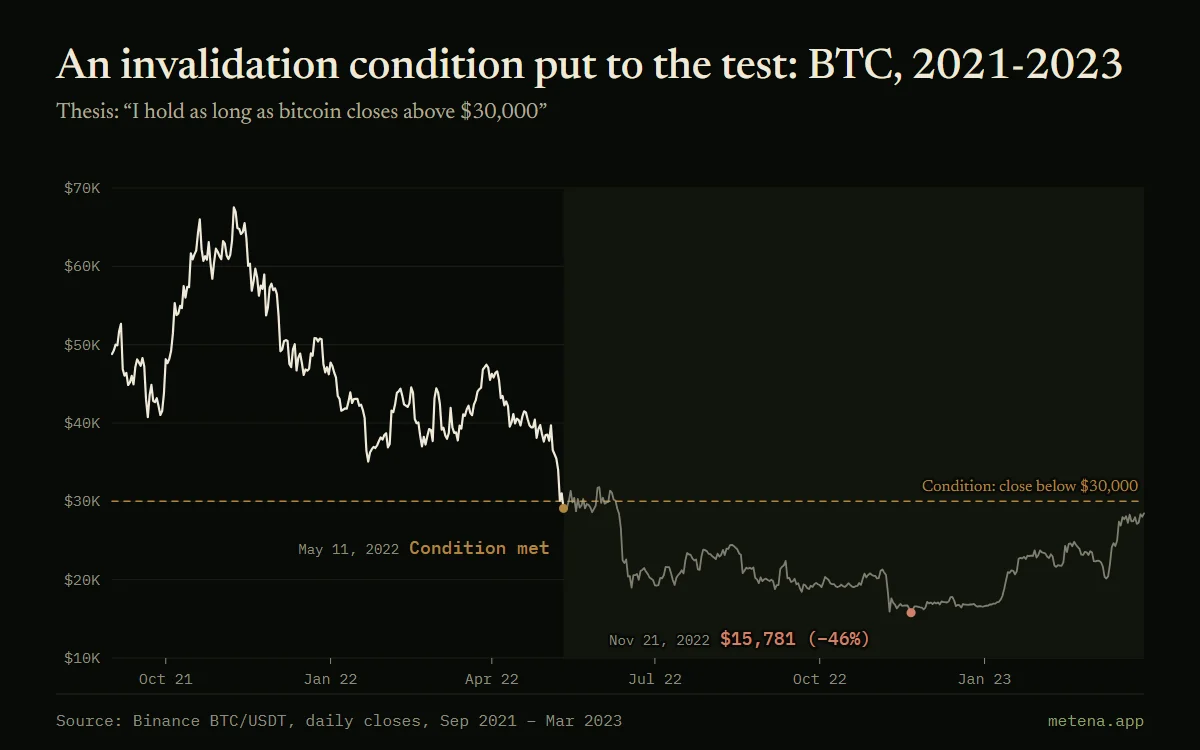
The stop reacts to the price. The invalidation condition reacts to the facts. It describes what, if it happened, would prove wrong the reason you hold the asset: a change in regulation, a lasting loss of users, a stablecoin that loses its peg.
A good invalidation condition is observable and dated. “If the fundamentals deteriorate” allows no decision. “If network activity falls for two quarters in a row” allows one.
When the condition is met, the position is sold whatever the price, including at a profit. This is the hardest rule to follow, because the market can keep rising after the reason to buy has disappeared.
Selling to return to your allocation
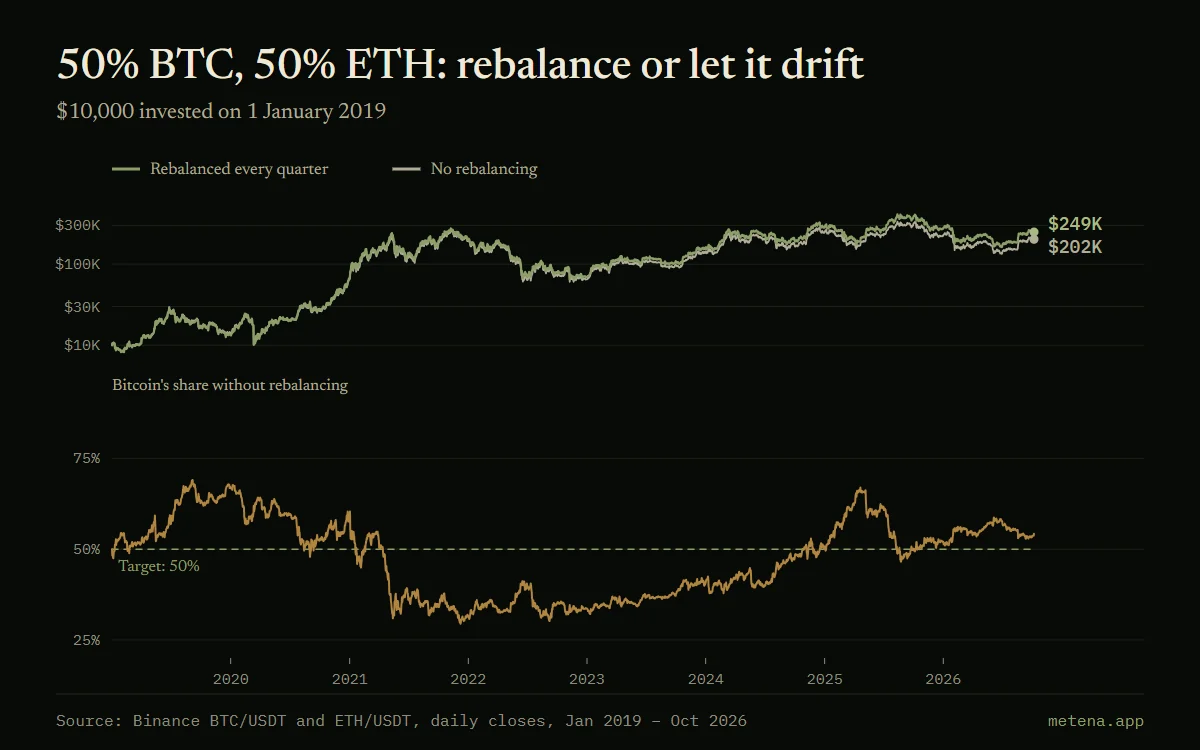
An asset that rises a lot ends up weighing more than planned. A portfolio built with 50% bitcoin can find itself at 65% after a rise, with a risk you never chose.
Rebalancing sells part of what has risen to return to the target. There are two triggers: a fixed date, every quarter for example, or a gap, when an asset moves away from its target by more than ten points. The gap rule acts less often, and only when the portfolio has actually drifted.
Each sale has a cost: fees and, depending on your country, tax on the capital gain. These costs are part of the choice of frequency.
Write the plan, then test it
An exit plan fits in a few lines per position: the selling levels and the share sold at each, the stop, the invalidation condition, the rebalancing rule. If one is missing, the corresponding decision will be made in a hurry.
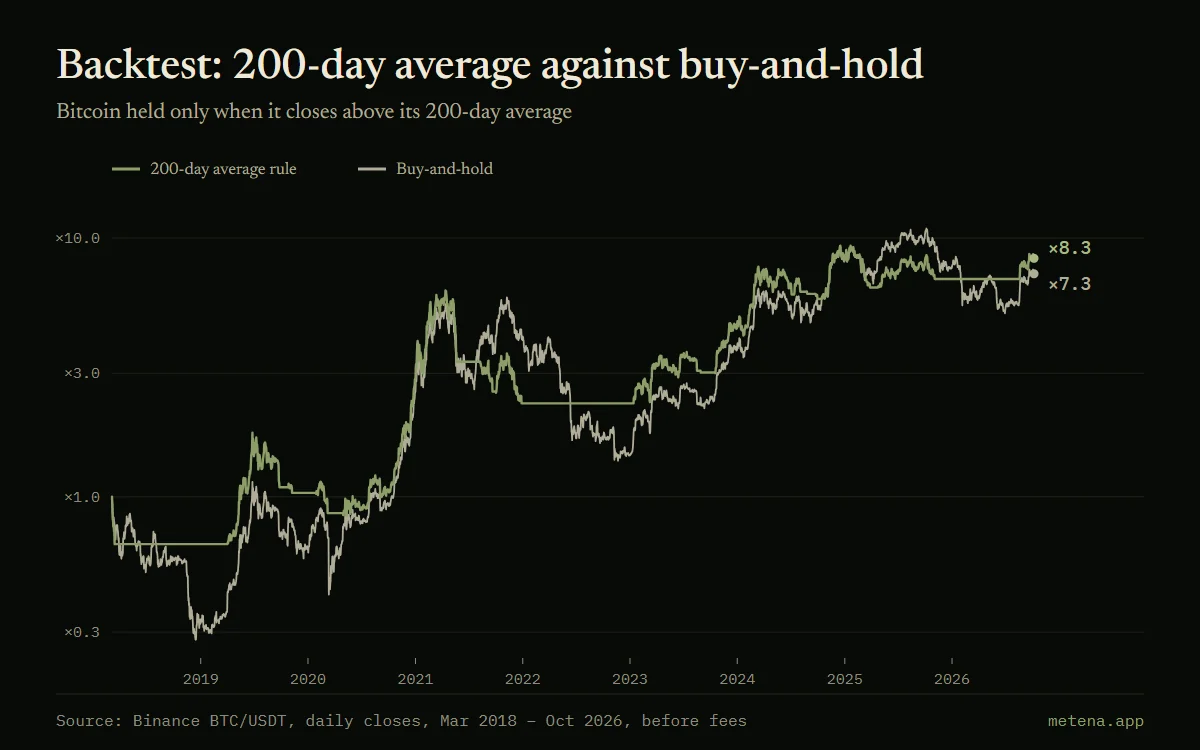
A backtest shows how these rules would have behaved over the price history: how many times the stop would have triggered, what the selling levels would have left on the table, the maximum loss endured. It does not predict what comes next, but it reveals the rules you could not sustain.
What remains is sticking to it. Keeping a journal of your sales, with the rule applied each time, is the simplest way to see whether the plan is followed or bypassed.
In Metena
In Metena, you note your take-profit levels on each position, next to the stop. A sale planned by your rules and then carried out counts as a decision in line with your plan in your discipline score.
Notify me at launchGlossary terms
- Take-profit
- A price level set in advance, at which you sell all or part of a winning position.
- Stop-loss
- A price level set in advance, below which you sell to limit the loss on a position.
- Invalidation condition
- The precise fact that would prove your thesis wrong and trigger your exit, for example “I exit if BTC closes two weeks below $20,000”. Writing it in advance stops you rationalizing it later.
- Rebalancing
- Adjusting the portfolio to get back to the planned allocation when one holding has risen or fallen too far compared with the others.
- Average cost (cost basis)
- The average price at which you bought an asset, fees included. Above that price, the position is in profit.
- Thesis
- Your reason for investing, written down: why you buy, over what horizon, and what has to happen for you to be right. A clear thesis stops you improvising when the market moves.


Related guides
- Building a crypto strategy from A to Z
- Thesis, allocation, position sizing, entry and exit rules, testing: the parts of a written crypto strategy, in the order in which they are decided.
- Bitcoin DCA: what seven years of data show
- Investing a fixed amount in bitcoin every week: real results since 2019, comparison with a lump sum, the worst time to start and the average cost.
- How to read a crypto backtest without being fooled
- Return, maximum drawdown, overfitting, Monte Carlo: how to read the results of a crypto strategy backtest, with real bitcoin examples.
- Writing your investment thesis and invalidation conditions
- How to write a crypto investment thesis, turn it into rules and set invalidation conditions, with the real examples of Terra-LUNA and FTX in 2022.
- Crypto risk management: position sizing, leverage and liquidation
- How much to put in each position, what leverage really changes and why diversifying across cryptocurrencies protects little: real bitcoin and ether examples.



Put these ideas into practice.
Write your strategy in a few minutes: Metena analyses it when you ask and explains each term in context.
Notify me at launchEducational content. It is not investment advice. Crypto-assets carry a high risk that can go as far as the total loss of capital.