 Metena
Crypto rebalancing: definition and simulation
Adjusting the portfolio to get back to the planned allocation when one holding has risen or fallen too far compared with the others.
Definition
Left alone, a portfolio’s allocation drifts: the position that rises most takes up more and more room, and risk concentrates on it.
Rebalancing means selling part of what has risen most to buy back what has lagged, on a fixed date (every quarter) or when the gap passes a threshold (for example 10 points). It does not guarantee a better return: it keeps the risk you chose.
How to read the chart
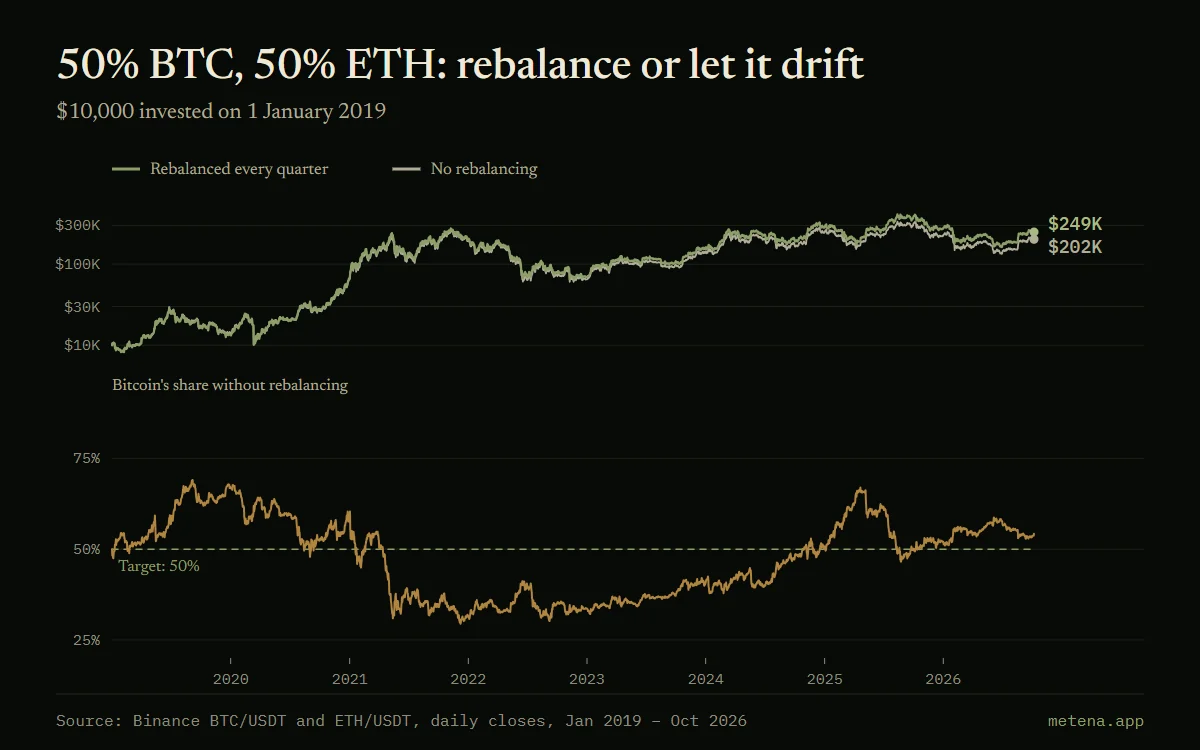
At the top, the value of $10,000 invested on 1 January 2019, half BTC, half ETH: in green with a rebalance every quarter, in grey with no intervention (logarithmic scale).
At the bottom, bitcoin’s share of the portfolio without rebalancing. The green line marks the 50% target. Any gap is a risk you did not choose.
Worked example
Without rebalancing, bitcoin’s share rose as high as 69% and fell as low as 29% depending on the period. On 7 October 2026, the portfolio rebalanced every quarter is worth $248,509, against $202,245 with no intervention, before fees and taxes. Over another period, the gap could go the other way.
In Metena
You can write a rebalancing rule into your Metena strategy, on a fixed date or by drift threshold, then replay it in the backtest.
Notify me at launchRelated terms
- Money management
- Managing the size of your positions and your exposure: how much to risk per holding, what reserve to keep, which limits never to cross.
- DCA (Dollar-Cost Averaging)
- Investing a fixed amount at regular intervals, for example every week, whatever the price. It smooths your entry price and stops you hunting for the “right moment”.
- Backtest
- Replaying a strategy on past data to measure what it would have delivered. Useful for testing rules, but the past does not predict the future.
- Volatility
- The size of an asset’s price swings. High volatility means large moves, up as well as down.
- Asset allocation
- How your capital is split between several assets, expressed as target percentages.


Related guides
- Crypto risk management: position sizing, leverage and liquidation
- How much to put in each position, what leverage really changes and why diversifying across cryptocurrencies protects little: real bitcoin and ether examples.
- When to sell your crypto: writing your exit plan
- Take-profit levels, stop, invalidation condition, rebalancing: four reasons to sell that should be written before buying, with worked examples.

Put these ideas into practice.
Write your strategy in a few minutes: Metena analyses it when you ask and explains each term in context.
Notify me at launchEducational content. It is not investment advice. Crypto-assets carry a high risk that can go as far as the total loss of capital.